Headworx

Headworx is a collection of brainstorming ideas and thoughts on technology. Most are inspired by a group of friends of mine and many interesting things I come across everyday.

Subscribe: [RSS Feed]


Twitter updates

    Sunday, October 28, 2007

    i-Mate Momento: Connected Photo Frame


    I remember back in 1987 at the university, we had a lecture on liquid crystals. Two weak points were mentioned in reference to this technology: first, the LCD displays were monochrome, and second, they were too slow to be used to display motion pictures. Five years later I bought my first color LCD laptop (so called active matrix those days) and it had bright and clear and fast LCD display, violating just about everything I had learned about liquid crystals a few years before. The drawback was the price, something in the range of 10 thousand dollars. And today? We have LCDs everywhere. From watches to mobile phones to digital cameras to MP3 players to computers to TV sets... And now even the photo frames have LCD displays. That is natural... why use paper to print digital photos, when you can upload them directly to a "frame". Or a couple of them. As I write, a typical, decent 7 or 8 inch photo frame costs some 100 dollars. They used to have fairly low resolution (480 horizontal pixels), but now for the same price we can get 800x480 models, and they are quite nice. Most of them have multiple memory card slots, so you can just take a memory card from a camera and pop it in the photo frame and the slide show starts. They also have some internal memory and an USB interface, so the pictures can be uploaded by cable.

    i-Mate has recently taken the photo frame concept almost where it should be. The Momento frames (7 and 10 inch models available) have a WiFi radio on board. And that makes a difference. Using the on board WiFi the frame connects to your home WiFi network, and then, via your router can reach out for the World. The WiFi local area connection is handy, as you do not need any cables to upload new pictures. What is more, it can automatically pull the picture libraries you share with the Windows Media Player. And if you have a Windows Vista computer, you can set up the frame as a SideShow display using one of the Vista gadgets. But it really gets interesting when you let the frame connect to one of the Internet cloud services. I-Mate prefers you to go to their momentolive.com service, but with some configuration work you can have it connected to the RSS feed of your Picasa Web Albums. So whenever you post a new picture to your Picasa Web Album, it shows up on the frame, even at the other end of the World... Isn't it a great way of sharing pictures with family and friends?

    What we really need now are cameras able to upload photos to Picasa with a press of a button. Over WiFi or 3G. Yes, 3G... the carriers would be ecstatic about the prospects of selling yet another SIM card with a data plan to let your digital camera connect... The technology is here. What we need now is some integration work and a seamless user experience. Qualcomm should also be very positive about this concept... Jeff Belk - could you please comment on that?

    Sunday, October 21, 2007

    Graphics Processors (GPUs)


    For years ATI and NVIDIA, known for their high performance graphics boards, have been the synonyms of fast games. Recently everybody have been talking about Sony PS3 and its ultra high performance graphics based on the NVIDIA RSX engine coupled with the Cell processor. And suddenly it looks like what was initially designed for games finds its way into high performance servers.

    A few days ago Wired reported about an astrophysicist who replaced his number - crunching supercomputer with a cluster of PS3s. This trend becomes even more mainstream, as some serious companies offer serious programming tools. Terra Soft Solutions has a version of Linux tailored for the PlayStation and RapidMind offers its stream programming toolkit for the console. This year's acquisition of PeakStream (a competitor to RapidMind) by Google amplified the trend even more. All these platforms and solutions share a common paradigm - multiple processing cores and parallel execution of tasks. What seems now a "new" trend by Intel and AMD, has been mastered for years by the graphics chips designers. Not long ago these chips were very difficult to program and their flexibility was not enough to run generic purpose algorithms. Now this has changed and with supply of tools easing the translation of linear code to multiple processing cores more and more companies turn to GPUs.

    I have recently attended a jaw dropping presentation by Jules Urbach of otoy.com. With real time ray tracing and servers equipped with GPUs they can generate high resolution virtual reality with a movie quality. They have some screenshots on their site, so looking at them you may feel what the quality they have is like, but bear in mind they can do this at 30 frames per second and everything is being synthesized from preprogrammed models. What has never been possible even with the fastest computers so far, thanks to GPUs is now within a reach even with relatively small budget.

    So the next time you buy a graphics card for your gaming PC, think of it as of a single board supercomputer :)

    Sunday, October 14, 2007

    di-GPS (a GPS solution for Nikon and FujiFilm)


    Exactly a year ago I posted about GPS devices. Part of the post was about GPS - enabled cameras and how automatic geo-tagging of pictures would streamline the process of sharing and storing the pictures. Now after a year the GPS technology has made inroads into many consumer products, but I am still not aware of any consumer photo camera with built in GPS unit.

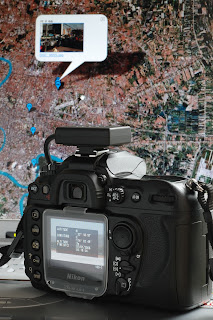
    On the other hand as some of you already know, I have been shopping for a new DSLR camera recently. I finally settled on the FujiFilm S5 Pro and one of the important contributors to my decision (versus Sigma SD14) was the GPS support. The FujiFilm S5 Pro is an interesting design, as it is based on the Nikon D200 body (I posted on the S5 Pro last month), and supports most of the accessories designed for the Nikon, GPS being one of them.

    I was naive to expect the Nikon GPS solution would be elegant. But the reality is Nikon is not an iPod and while being a "professional" it is quite often bulky and conservative. So how do you actually equip a Nikon camera with a GPS unit? The starting point is the MC-35 GPS Adapter Cord. Costing half of a kingdom, this is just a cable, not GPS! Just a cable with a Nikon proprietary plug on one end and a bulky DB9 RS-232 plug on the other end. Then, according to the product manual you need a GPS unit (like the Garmin eTrex) and another RS-232 cable with another bulky DB9 RS-232 connector. The good news is this setup works. The bad news is it costs a fortune and weighs (two cables and a GPS) as much as the camera itself. No... that was not what I really wanted.

    So I started searching the Web for a better solution. This solution ranked second on the Google's search result. It just shows how determined Nikon users are to have a decent, streamlined device. But really should it be that way: buying a top DSLR body and then spending a week in the garage with a drill and soldering iron to fix everything in place? Noo... while better than having two big plugs and an unnecessarily long cable, this was not a solution I was ready to accept. So the search went on... I found the solution from www.redhensystems.com, but this was not meeting my expectations either. And finally there it was: di-GPS from a small Hong-Kong company called Dawn Technology Limited. As it seemed what I wanted, I clicked on the purchase link, despite the hefty $283 price tag and in just two days it arrived at my doorstep and works flawlessly since then.

    The di-GPS is based on the SiRF Star III platform, still one of the best GPS chipsets available. It has great sensitivity, so it picks GPS signals even in poor conditions like beneath trees or in urban areas with tall buildings around. The only problem I noticed is the long position acquisition time when moving at a high speed, especially on a jet plane, but while it would be potentially handy to have pictures from a plane geo-tagged, this is not what you do very often.

    The di-GPS story tells us two other things. First there are great niches for small, but great niche companies, Dawn Technology being a perfect example here. Perfect product and perfect handling resulting in a very happy customer, willing to spread the word. And second - the power of the Internet and global reach it gives to small companies thinking on a global scale. The di-GPS unit I ordered Sunday evening arrived from Hong Kong to Poland in two days, usually it takes longer for local products to reach me. So the physical distance really does not matter these days.

    Saturday, October 06, 2007

    Buying CDs = Stealing Music?


    I was completely surprised when I learned last week that copying music I owned was actually stealing music. Jennifer Pariser, the head of litigation for Sony BMG, during her testimony on October 2nd, 2007 said "When an individual makes a copy of a song for himself, I suppose we can say he stole a song." and then that making "a copy" of a purchased song was just "a nice way of saying 'steals just one copy'". First I thought I misunderstood something, so I kept on reading...

    So for all my life I have been purchasing CDs just to learn when I rip one to my iPod, I am stealing? Seems like a good reason to stop buying CDs at all. I do not remember when I listened to the physical CD I had bought. I buy them, rip to the iPod and put back on the shelf. Listening to a CD is so inconvenient these days... I think not many people do it the way it was originally designed. But if this is a crime, then fine, I will not buy a CD anymore. At least not a "legal" one. In her testimony Pariser noted that Sony BMG was half the size now as it had been in 2000, thanks to piracy. I think with leaders like the current chief lawyer Sony BMG will soon be half the size as it is now. Instead of focusing on promoting clear nonsense, they should finally accept the world is moving ahead and look for their new role in the digital and probably virtual reality.

    I won't be surprised to learn next week I need to buy a second copy of a CD to listen to a music while playing Second Life... And I don't think anybody will treat these guys seriously... Their mission should be to represent the interests of the artists and I don't think they fulfill that mission anymore...