Posts

Showing posts with the label Low Energy

Solar Cameras

Image
During the COVID-19 time, stuck at home with no travel, I upgraded my home automation sensors with photovoltaic energy harvesting . After five years now, I can definitely say this has been working. Practically I'm left with just one battery-powered sensor: it is in a bathroom, and the photovoltaic energy budget there is close to zero (no windows, lit by two dim lightbulbs only very occasionally). All others have been "just running", doing their daily jobs. But this application (pushbutton wireless switches and occupancy sensors) has very low energy requirements. This summer I was attracted by the concept of solar-powered wireless cameras. I have a couple of PoE cameras made by Reolink (they are good and do not require any subscription). I was skeptical about a solar panel ability to power a device like a WiFi camera, but - surprisingly - it works. The camera has been strapped to a tree and overlooks part of my property and the bundled 3W solar panel has so far proven to ...

Carbon Footprints

Image
Sustainability discussions have become mainstream now. And the theme is very broad, touching essentially every aspect of our lives. Cars have however always occupied the center stage, especially now as electric vehicles (EVs) take over traditional internal combustion engine (ICE) based - mostly in China and Europe. Feeling a bit guilty here - as an owner of a 20+ years old Subaru Forester, I did some math (seeking some absolution). I don't drive much with this car though, maybe a bit over 5000km per year, so the initial feeling was that my contribution to the global carbon footprint would not be super high. For comparison I took the additional footprint of flying intercontinental in business class vs economy (more floor space, heavier seat etc., and all those bottles of champagne on board) and the global reduction impact of the lighting control software my company makes. So here is my math: The car: 5000km is about 600 liters of fuel. Burning 1 liter produces roughly 2.3kg of CO2. ...

Bluetooth Progress

Image
No, I cannot tell the details. Development of Bluetooth ®  specifications is governed by the confidentiality rules. So the only way to learn more is to be a Bluetooth SIG member and join the Working Groups. As I write this, the June Members' Summit in Milan, Italy is getting to the end. The week has been really packed. And as I have been excited about the progress on many fronts since I joined the SIG in 2012 (and then started to lead the Mesh Working Group in 2015), the excitement this week has reached all time highs. These things are complex and may seem to move slowly for casual observers "when will Bluetooth finally do X,Y,Z?", I've been super happy with the progress. To be honest, the progress is the one thing, but entirely more important is the spectrum of opportunities and the roadmap ahead. For the last couple of years, in parallel to development of Mesh / NLC - specific features (like the HVAC Integration Profile) , we have been doing a lot of ground work on ...

Bluetooth Group Broadcast Audio

Image
I have recently had a chance to play with a new prototype Bluetooth Low Energy Audio device. Or - should I be more specific - a new application (firmware) for an existing audio device that uses Bluetooth Low Energy Audio. Think of it as any type of wireless earbuds or headphones or - increasingly popular - smart glasses with audio microphones and tiny speakers. The feature allowed an unlimited number of people who were in the radio range to talk to each other. Essentially a voice group chat. That does not sound too exciting (definitely less than a space AI data center), but really brings the Bluetooth audio experience to a completely new level. Thing of it as voice chat rooms. Virtual rooms that you can "enter" with your earbuds and then chat with people. In a similar way to a Zoom call, but locally, peer-to-peer, without any supporting infrastructure or Internet connectivity. Great for events but also great for variety of other activities such as hiking or white water raftin...

Lighting Goes HVAC

Image
The IES Annual conference has always been the temple of light. Stunning designs, beautifully illuminated spaces, and the role of light in human wellbeing. In 2025 this has changed. The Gala and the Awards were still about illumination, but the technical sessions started to boldly drift away, to discuss - surprise, surprise - heating, ventilation, and air-conditioning. All with connection to light of course. Or - to be precise - to occupancy sensors brought to buildings en masse thanks to lighting. HVAC is shaping up to be the first significant beyond-lighting application. Forget wayfinding beacons. Forget asset tracking. Forget space utilization heatmaps. It is still all about energy savings. The lighting folks realized the HVAC crowd was unable to pull it on their own. So have come to offer the helping hand: the Lighting-HVAC Integration. As I cried almost 10 years ago - for the connected products to get really connected, we need cross-domain industry experts. And this has been happ...

DALI+ over Thread: Capacity

Image
The post on  Bluetooth NLC vs DALI+: Capacity and Performance has generated very valuable feedback. I promised to shed some more light on my network capacity calculations, so here they are. The key assumptions are: - The Thread network operates at 2.4GHz using IEEE 802.15.4 data links at 250kbps; - Transmitting nodes use Carrier Sense Multiple Access with Collision Avoidance (CSMA/CA) method to manage the shared communication channel; - Each unicast transmission is acknowledged - There are two hops (say: sensor → router and router → lighting controller) - The minimum data frame at PHY is 50 octets (+6: preamble + SFD), so ~1.8ms - The ACK frame (including the SIFS time) is ~0.5ms - The average CSMA/CA overhead is ~1.4ms That gives us 3.7ms per hop total. So with two hops we have the channel occupancy of 7.5ms. At full 100% channel occupancy that would give us capacity of 135 end-to-end messages per second (one way). But... 100% would simply kill the network. Thread is very fr...

Bluetooth NLC vs DALI+: Capacity and Performance

Image
Whenever I come across a discussion that involves wireless communications over the Thread protocol (such as this one ), there is almost 100% chance people don't understand the underlying physics and traffic patterns. This is the result of Thread marketing since 2014, highlighting the IPv6 protocol as its key strength. And typically it goes like that: "Thread is based on IPv6 and there are more IPv6 addresses that grains of sand in the Universe". And people read this "because Thread is based on IPv6, it is a highly scalable wireless protocol". Treating the potential number of static addresses equally to the dynamic situation when these devices actually send data. If we consider the networked lighting control domain, the most prevalent pattern today is to have a motion sensor in every luminaire. The motion sensor usually has multiple functions: it is a motion sensor of course. But it also is a light level sensor enabling daylight harvesting (or dimming lights down...

Home Assistant Brings the Watch Battery Down

Image
This one is quite interesting and I am yet to collect the hard evidence on what really happens. Long story short: Home Assistant can, behind the scenes, drain battery in a smart watch. It all leads back many months ago when I started seeing my Garmin fÄ“nix  watch dead every morning. I mean ALMOST every morning. Normally it can run for 1-2 weeks on a charge and suddenly every morning it was dead, despite being fully charged on the day before. I tried different things - software/firmware update of course, changing some parameters (but it had been working fine before) - no lasting improvement. Until this June (after having extensive travel period - US West Coast, twice to China and then Europe), when I realized that it did not lose the battery when I was away from home. I started thinking on what was so special at home that the watch, left for the night on my bedside table, was losing the charge completely. There was one idea that came to mind: Home Assistant. And to be precise: ...

We Have a Liftoff

Image
SILVAIR published the Q1-2025 report on May 15th. Bound by the corporate governance rules I could not share our progress earlier, but now the cat is out of the bag. We had a stellar quarter. Q4-2024 was record and always in such cases the worry is if the trend would continue. It has continued. Even stronger. Despite the US trade wars introducing uncertainty in the markets. Fundamentally I think there are couple of jointly contributing factors to our overall progress: Brand recognition. Despite very low marketing budget, we continue to be increasingly more recognized. And this is both Bluetooth NLC as the only truly interoperable wireless lighting control standard, and Silvair as the leading product based on this standard. Both brands are associated with performance, quality, robustness and ease of use. A perfect combination of features. The product feature set is increasingly more complete, particularly addressing the needs of customers in the enterprise segment. Network scalability ha...

Losing the DNA

Image
I blogged in the past about my love-hate relationships with Bluetooth products and Logitech was brought as the example of a company that maintained technical excellence while losing on the support / delivery side . I was still bringing the excellent product aspects of the KEYS-TO-GO 2. That opinion was based on my initial product experience. After several months of using the keyboard on a daily basis, I must unfortunately admit the product is not so great after all. As a matter of fact it can be quite annoying (but there are workarounds). The key problem (pun intended!) with KEYS-TO-GO 2 is it is powered by coin-cell batteries. And the batteries die quickly and without any warning. The power consumption is not as bad as the other Kickstarter keyboard I had in the past . But still since purchasing the keyboard 9 months ago, I had to replace the batteries 3 times. That means batteries last for 3 months on average. That is a far cry from the advertised 3-year lifespan . Although, to be fa...

Power Over Data

Image
Delivering power over wired data lines has been one of the most obvious extension to many legacy protocols. It is hard to comprehend why many of these protocols did not have the power option from the beginning, requiring the connected devices to be fed power over a separate line (and a separate cable). Less cables is always good. My own journey with cutting power cables started about 40 years ago when I designed my first commercial product - a software protection dongle. The dongle was using the PC printer port for communication. Unfortunately the printer port never had power lines in it, but I managed to harvest sufficient energy from the data lines.  Next in line was USB , and the inclusion of power was a very significant (if not the most significant) contributor to the success of the standard. Now with the Power Delivery (USB-PD)  capable of carrying up to 240W of power, the PD is the king of power-over-data standards. HDMI is the one that really failed to do this properly....

Atomic Radios

Image
Radio was invented in 19th century. Everyone knows the principle. Radio waves are an electromagnetic field. Then there is the antenna. Radio waves induce a small current in the antenna. The current is then amplified and processed to deliver the encoded information. Antennas have always been inherent to radios. In fact you can attach a piece of wire to an earpiece from an old telephone handset and that is sufficient to receive AM-modulated signal if you are close to the transmitter (this was the first "radio" I built as a young boy). There is a totally new approach to receiving radio frequency (RF) signals. The approach based on quantum physics and special behaviors of single atoms. Called Rydberg Atomic Quantum Receivers (RAQRs) the technology has really mind blowing prospects. RAQRs involve Rydberg atoms (atoms in highly excited states, achieved with lasers). The excited electrons appear to be sensitive to RF signals. Rydberg atoms can absorb energy of RF signals to transit ...

Simplicity Through Hidden Complexity

Image
Often in many discussions people bring up new technologies that "radically" simplify end products. Common examples are electric vehicles (EVs) - Tesla and others, rocket engines (SpaceX). Also in my own domain - the Bluetooth NLC wireless lighting control, as opposed to wired (or even other wireless) systems that are based on central control boxes (DALI, KNX, and many similar). Indeed there is radical product simplification. It is much easier to compose an EV out of components: a battery integrated with a battery management system (BMS), an integrated motor / drive train, then chassis / suspension, body covers and you're done. It is also way, way easier to commission a Bluetooth NLC lighting system, as essentially all that is needed is a wireless node in every luminaire. No extra wires (other than line power), no control boxes (the nodes talk to each other and collectively agree on what to do). In the Bluetooth NLC case the end product simplicity (which is highly desired...

Power Runaway

Image
Managing energy consumption in battery-powered electronic gadgets is one of the most difficult engineering tasks. And no one has dine it 100% right. Low power consumption is only achieved through managing the device activity. A device may really be designed to and perform consuming manageable amount of energy, until once in a while it runs away and dies. A 2018 MacBook Pro runs for 8 hours under macOS and only 90 minutes under Windows. The reason? The accelerated graphic card (the ATI Radeon GPU) is tightly managed by macOS (by switching it off and using the integrated low-performance / low-power Intel GPU). Wen booting Windows, the Apple BIOS disables the Intel GPU so Windows has nothing to switch back to and consequently draws batteries at full speed. My Garmin Delta watch has a habit of draining its battery to death in the night when it repeatedly attempts to connect to the iPhone to sync data. I have a habit of leaving the watch on a kitchen table and taking the phone with me to t...

New Bluetooth Audio

Image
This post is way overdue. But it is only now that the new Bluetooth® audio technology - the LE Audio is finding its way into products. It has been 10 years in the making. Internally LE Audio is super complex as it aims to propel wireless audio for the next 20 years (or more). My personal picks (in no particular order) of the features enabled by LE Audio are:  It uses the underlying Bluetooth Low Energy (LE) transport. Which not only means longer lasting earbuds, but most importantly Bluetooth-enabled hearing aid devices. It also means better behavior at higher packet loss - (longer range and dense/interfered environments). It introduces the new LC3 audio CODEC, which offers better perceived audio quality at half the data rate (compared to the old Bluetooth SBC) AND an order of magnitude better latency (down to 20-30ms range). Think about the impact of that on teleconferencing (and gaming of course). It natively supports multiple audio streams, so joint / shared experiences are now...

The Core Values

Image
I've been quite successful completing my backup travel PC (more on that in an upcoming post). One component I needed was a travel keyboard. Ideally that keyboard could be also paired with an iPad. And it should be both comfortable and light. Connecting via Bluetooth and living forever without charging. Of course that last requirement is quite difficult to address. I mean it is easy to imagine harvesting energy - back in the 1990s Compaq even had a laptop which was recharged through keystrokes (magnets moving inside small coils generating energy). But such keyboards are loud and heavy. My initial thoughts were to check Logitech. They used to have a wide selection of wireless products. And the core value proposition from Logitech always has been seamless connectivity and very good power management. Just to put things in perspective - here is the blog post discussing how bad a good keyboard experience can be when connectivity and power management are ignored. It also explain why I r...

Digital Fragility

Image
Everything is digital and therefore software-driven today. And that software is getting super complex, with tons of layers and dependencies. This complexity, statistically, leads to many failures which in the end are unavoidable. No matter how thorough the testing is, it is impossible to cover and catch every possible scenario. Even simple stuff like alarm clocks sometimes fail to go off. Something unthinkable in the old days of mechanical alarm clocks. And there are times when a working alarm clock is critical. Such that when you have an intercontinental flight to catch early in the morning. Just recently Apple has confirmed the iPhone alarms may not go off due to a software bug. That is why even being a digital gadget geek, I have a rule to set up an analog alarm clock just in that case - an early morning flight. To regular people this is something close to unthinkable - the most premium mobile phone, with millions of users and billions of R&D and QA budgets behind - can still ...

MH370 Whispers

Image
In the "everything's possible" era we live in, there are indeed very few surprises, particularly when it comes to technology. With abundant AI, self driving cars, gigabit internet available everywhere, we are about to colonize Mars while James Webb keeps sending us postcards of black holes and galaxies formed at the very beginning of time. The lost Malaysian MH370 aircraft - it was 10 years ago - is probably one of those things which have been impossible. The worlds largest twin engine aircraft just disappeared and we have not been able to find it. Now the jaw-dropping surprise is it actually left a trace, which had not been analyzed until last year. The trace is WSPR or Weak Signal Propagation Reporter . WSPR is a protocol designed to probe global propagation paths with low power transmissions, designed by Joe Taylor, an American astrophysicist and Nobel Prize laureate in Physics. WSPR would probably stay ultra niche, but in May 2021, Richard Godfrey, an aerospace engine...

900Mhz Long Range WiFi (HaLow)

Image
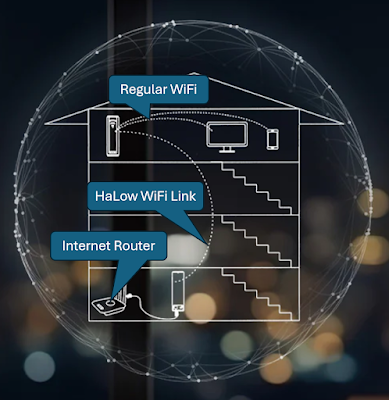
One of the most common complaint on WiFi is the range is often not sufficient. You have this door bell / camera by the property gate which does not connect or a thermostat in the basement. WiFi mesh systems help solving some of these problems (while introducing others), but in some situations you simply need more per-hop range. In commercial / industrial environments, such as served by Bluetooth mesh / Bluetooth NLC networks this is rarely an issue (Bluetooth can reach really far if properly configured), home users would clearly benefit from something like long range WiFi. If it existed. And actually it does exist. The standard is called 802.11ah (or HaLow) and is a long range WiFi standard, operating in the sub-GHz frequency band. Lower frequency comes will much lower throughput, but it has the benefit of lower attenuation. In short - it passes through more walls or goes longer distance. As this is a different radio frequency, none of your laptops of smartphones are able to connect to...

Bluetooth NLC: 100% CAGR

Image
ABI research has recently released a comprehensive study covering Bluetooth® technology in industrial applications. The report is titled "How Can Bluetooth Technology Enable Digital Transformation Across The Industrial IoT?" and can be downloaded here: https://go.abiresearch.com/lp-how-can-bluetooth-technology-enable-digital-transformation-across-the-industrial-iot . It is important for a number of reasons. In the past Bluetooth had been associated with simple short range connections between consumer products and accessories. In other words - small scale topologies in not very demanding applications. The ABI paper is one of the first exploring the large scale deployments in demanding industrial applications. The applicability of Bluetooth technologies to industrial applications is not a surprise to those deeply familiar with the technical aspects of Bluetooth - after all this is the most potent low power wireless technology available. Plus it has super long term and ambitious...