Posts

Showing posts with the label Mesh

Power Cycle Kills

Image
Last week I had an overnight layover at the San Francisco airport. Landed in the afternoon and then took the hotel shuttle bus to the nearby hotel. It turned out the bus could not enter the hotel parking area: the automatic barriers were lowered and a number of cars before us was already lined up. We ended up disembarking the bus on the street and walking up to the hotel. The front door did not open. "We have a power outage" - a staff member explained - please use the side door. I did. Then the check-in was by means of writing my name and CC number on a piece of paper and walking up the stairs to the 3rd floor. I still could open my room with the keycard (battery-operated?) but inside it was dead silent - no usual ventilation hum. There was no WiFi either.  They fixed the power in the evening, but many systems still did not work. Elevators required a service company next day to get started. WiFi was on but the captive portal did not work until next morning. This whole situati...

Lost in Translation: Where People Get DALI Wrong (1)

Image
The DALI (Digital Addressable Lighting Interface) standard has had a very uphill battle in the USA. Lots of resistance, mostly quoted to it being problematic and expensive. On the other hand DALI has almost 100% market share in Europe and similarly in Asia and Middle East. DALI Alliance has been trying to change this, addressing the North American market with several campaigns, but they have not been too successful so far. And the reason is, despite DALI being a very good technology, there are many misconceptions, false myths, contradictory statements (even by the DALI people themselves). Here I'll address some key concepts that people often get wrong or are falsely propagated even by those who should know in the first place. DALI is polarity free. I have heard this so many times. Even from the founding fathers of DALI. So yes, in principle it is, but in practice it is not. DALI bus signaling works by shorting the bus. There are two wires and there is small DC (around 18V) current ...

The Digital Lag

Image
I discussed the issue of latency many times here on this blog. Typically understood as the delay of a reaction on human input . This has been the issue (and one of the key performance metrics) in computer gaming. There is a human interface device (HID) controller such as a joystick, it processes the physical inputs, transmits them to the computer or a gaming console that does it's own processing and renders the output scene which is then pushed as a stream of digital signals to a display. The display (monitor) also has its own lag - a parameter that differentiates gaming displays from (cheaper) office displays. (The reduction of) the lag is also what is driving mobile devices such as phones and tablets to support higher screen refresh rates. Also what from the very beginning was the iPhone differentiator was the smoothness of the reaction, something that Android was struggling with for several years. Google even had its special focus "Project Butter" - the effort in Andro...

Lighting Goes HVAC

Image
The IES Annual conference has always been the temple of light. Stunning designs, beautifully illuminated spaces, and the role of light in human wellbeing. In 2025 this has changed. The Gala and the Awards were still about illumination, but the technical sessions started to boldly drift away, to discuss - surprise, surprise - heating, ventilation, and air-conditioning. All with connection to light of course. Or - to be precise - to occupancy sensors brought to buildings en masse thanks to lighting. HVAC is shaping up to be the first significant beyond-lighting application. Forget wayfinding beacons. Forget asset tracking. Forget space utilization heatmaps. It is still all about energy savings. The lighting folks realized the HVAC crowd was unable to pull it on their own. So have come to offer the helping hand: the Lighting-HVAC Integration. As I cried almost 10 years ago - for the connected products to get really connected, we need cross-domain industry experts. And this has been happ...

DALI+ over Thread: Capacity

Image
The post on  Bluetooth NLC vs DALI+: Capacity and Performance has generated very valuable feedback. I promised to shed some more light on my network capacity calculations, so here they are. The key assumptions are: - The Thread network operates at 2.4GHz using IEEE 802.15.4 data links at 250kbps; - Transmitting nodes use Carrier Sense Multiple Access with Collision Avoidance (CSMA/CA) method to manage the shared communication channel; - Each unicast transmission is acknowledged - There are two hops (say: sensor → router and router → lighting controller) - The minimum data frame at PHY is 50 octets (+6: preamble + SFD), so ~1.8ms - The ACK frame (including the SIFS time) is ~0.5ms - The average CSMA/CA overhead is ~1.4ms That gives us 3.7ms per hop total. So with two hops we have the channel occupancy of 7.5ms. At full 100% channel occupancy that would give us capacity of 135 end-to-end messages per second (one way). But... 100% would simply kill the network. Thread is very fr...

Bluetooth NLC vs DALI+: Capacity and Performance

Image
Whenever I come across a discussion that involves wireless communications over the Thread protocol (such as this one ), there is almost 100% chance people don't understand the underlying physics and traffic patterns. This is the result of Thread marketing since 2014, highlighting the IPv6 protocol as its key strength. And typically it goes like that: "Thread is based on IPv6 and there are more IPv6 addresses that grains of sand in the Universe". And people read this "because Thread is based on IPv6, it is a highly scalable wireless protocol". Treating the potential number of static addresses equally to the dynamic situation when these devices actually send data. If we consider the networked lighting control domain, the most prevalent pattern today is to have a motion sensor in every luminaire. The motion sensor usually has multiple functions: it is a motion sensor of course. But it also is a light level sensor enabling daylight harvesting (or dimming lights down...

We Have a Liftoff

Image
SILVAIR published the Q1-2025 report on May 15th. Bound by the corporate governance rules I could not share our progress earlier, but now the cat is out of the bag. We had a stellar quarter. Q4-2024 was record and always in such cases the worry is if the trend would continue. It has continued. Even stronger. Despite the US trade wars introducing uncertainty in the markets. Fundamentally I think there are couple of jointly contributing factors to our overall progress: Brand recognition. Despite very low marketing budget, we continue to be increasingly more recognized. And this is both Bluetooth NLC as the only truly interoperable wireless lighting control standard, and Silvair as the leading product based on this standard. Both brands are associated with performance, quality, robustness and ease of use. A perfect combination of features. The product feature set is increasingly more complete, particularly addressing the needs of customers in the enterprise segment. Network scalability ha...

Have You Been Enlighted?

Image
The news of Enlighted shutting down the lighting controls business have been a real earthquake for the industry. Once the absolute champion and the leader in the lighting controls and IoT space has ceased to exist. Sadly, they have not been the first ones. There was Universal Douglas in 2023  and  Touché in early 2025 . But the Enlighted case has really transformed the company name into a verb. In a very bad way: "to be enlighted" almost feels in line with "to be musked": "to be musked" can mean to be treated poorly or "screwed over" by a company, often without apology. For example, buyers of Tesla vehicles might say they were "musked" if they experienced unresolved issues with their cars. This is a play on Elon Musk's surname and is used pejoratively. So have you been enlighted? We can help. The common theme across all the above mentioned "gone out of business" events is - they all were proprietary / vendor - locked solu...

Power Over Data

Image
Delivering power over wired data lines has been one of the most obvious extension to many legacy protocols. It is hard to comprehend why many of these protocols did not have the power option from the beginning, requiring the connected devices to be fed power over a separate line (and a separate cable). Less cables is always good. My own journey with cutting power cables started about 40 years ago when I designed my first commercial product - a software protection dongle. The dongle was using the PC printer port for communication. Unfortunately the printer port never had power lines in it, but I managed to harvest sufficient energy from the data lines.  Next in line was USB , and the inclusion of power was a very significant (if not the most significant) contributor to the success of the standard. Now with the Power Delivery (USB-PD)  capable of carrying up to 240W of power, the PD is the king of power-over-data standards. HDMI is the one that really failed to do this properly....

Jurassic Wires

Image
Some people are dinosaurs. Or at least behave like them. It is 2025 and promoting a wired lighting control system feels like you are from a deep past. Makes me wonder how you can still be alive at all? Bluetooth mesh has been around since 2017 - 8 years and counting. Millions of devices shipped, tens of thousands of commercial buildings deployed, happy customers and users, zero issues. And you still pitch cables? Arguing one cable system is better than another cable system because it uses less miles of cables drilled in the walls and laid in the plenum? That is definitely the feeling I had listening to otherwise great Lighting Controls podcast  episode 83 on DALI . And don't get me wrong - I LOVE DALI (it stands for Digital Addressable Lighting Interface). Actually I have been very actively participating in development of DALI, particularly working on the DALI-341 specification which links DALI and Bluetooth NLC based on the industry - approved architecture . For the uninitiated: D...

The First Million

Image
On December 17, 2024, we crossed the 1 million mark of manufactured devices with Silvair technology inside. It is a nice milestone. Of course. But somehow this was not what has recently been generating the enthusiasm among our employees and investors. It is the velocity with which we crossed that mark. A million units definitely means a lot. It means the product is wanted. It means there is a product - market fit. It means the quality is good (otherwise the support claims would have killed us). It means the supporting infrastructure can scale. And on and on. On the other hand 1 million is both big and small. We are still small. I was even contemplating if 1 million units was worth a public celebration. But again, it is about the velocity. While it took us 5 years to get to the first million (the first meaningful shipments were in 2019), it may take less that 2 years for the next million and then less than a year for the 3rd. People say 90% of lighting controls in 2030 will be wireless...

Simplicity Through Hidden Complexity

Image
Often in many discussions people bring up new technologies that "radically" simplify end products. Common examples are electric vehicles (EVs) - Tesla and others, rocket engines (SpaceX). Also in my own domain - the Bluetooth NLC wireless lighting control, as opposed to wired (or even other wireless) systems that are based on central control boxes (DALI, KNX, and many similar). Indeed there is radical product simplification. It is much easier to compose an EV out of components: a battery integrated with a battery management system (BMS), an integrated motor / drive train, then chassis / suspension, body covers and you're done. It is also way, way easier to commission a Bluetooth NLC lighting system, as essentially all that is needed is a wireless node in every luminaire. No extra wires (other than line power), no control boxes (the nodes talk to each other and collectively agree on what to do). In the Bluetooth NLC case the end product simplicity (which is highly desired...

900Mhz Long Range WiFi (HaLow)

Image
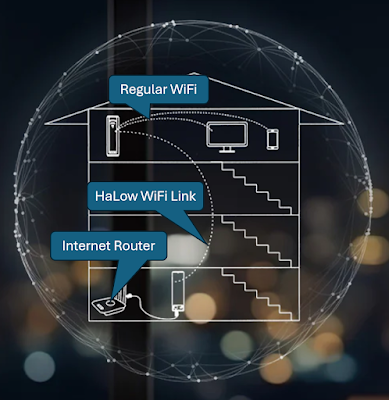
One of the most common complaint on WiFi is the range is often not sufficient. You have this door bell / camera by the property gate which does not connect or a thermostat in the basement. WiFi mesh systems help solving some of these problems (while introducing others), but in some situations you simply need more per-hop range. In commercial / industrial environments, such as served by Bluetooth mesh / Bluetooth NLC networks this is rarely an issue (Bluetooth can reach really far if properly configured), home users would clearly benefit from something like long range WiFi. If it existed. And actually it does exist. The standard is called 802.11ah (or HaLow) and is a long range WiFi standard, operating in the sub-GHz frequency band. Lower frequency comes will much lower throughput, but it has the benefit of lower attenuation. In short - it passes through more walls or goes longer distance. As this is a different radio frequency, none of your laptops of smartphones are able to connect to...

(Dim) Light Ahead

Image
My most remembered bus trip was in 2013 in Cambodia - a night ride from Phnom Penh (the capital) to Krong Siem Reap (the town near the famous Angkor Wat temple complex). The window views were absolutely unreal, as the darkness was impenetrable, with galaxies above our heads and hundreds of violet tubes on the horizon. The tubes were used to attract insects which were then captured and used as a food source. Insects are now considered super food and have been very popular in Cambodia for years. And the popular harvesting method is based on blue/violet light attracting them in the night. Insects' vulnerability to blue light has now become a serious problem. They were not affected by "warm" sodium street lights. But now sodium lights are being upgraded to LEDs, which emit way more cold/blue light which tricks insects. And they are dying . Which is a very, very serious problem. One of the biggest impacts of insect loss is on the many birds, reptiles, amphibians and fish ...

Bluetooth NLC: 100% CAGR

Image
ABI research has recently released a comprehensive study covering Bluetooth® technology in industrial applications. The report is titled "How Can Bluetooth Technology Enable Digital Transformation Across The Industrial IoT?" and can be downloaded here: https://go.abiresearch.com/lp-how-can-bluetooth-technology-enable-digital-transformation-across-the-industrial-iot . It is important for a number of reasons. In the past Bluetooth had been associated with simple short range connections between consumer products and accessories. In other words - small scale topologies in not very demanding applications. The ABI paper is one of the first exploring the large scale deployments in demanding industrial applications. The applicability of Bluetooth technologies to industrial applications is not a surprise to those deeply familiar with the technical aspects of Bluetooth - after all this is the most potent low power wireless technology available. Plus it has super long term and ambitious...

Open Standard Wireless LED Drivers

Image
We have talked a lot about Bluetooth NLC since the launch of the standard in September 2023. There are many dimensions impacted by this latest wireless lighting control standard. And the importance of it has already been correctly recognized by the policy makers and global market players world wide. There have been good interviews - with Bluetooth SIG's Damon Barnes and myself published - which I believe do a very good job explaining what Bluetooth NLC is and how it impacts connected lighting. DesignLights Consortium (DLC) has recently released a request for proposals for consultants to help define a clear pathway to adopting connected lighting for energy efficiency programs in North America. They nail the problem, which was the short term thinking in the past: In many present lighting retrofit projects, the extremely low cost of incentivized uncontrolled LED lighting is a major deterrent to networked lighting control (NLC) adoption. If uncontrolled LED lighting had no incenti...

Thank you 2023!

Image
It is quite straightforward to dedicate the last two blogs of the year to summarize the 12 months which have just been passing. So today a short reflection on the business (Silvair) side and next week on my personal front. Both have been challenging, required a lot of commitment but ultimately delivered great rewards. Those who follow our quarterly reports can see how 2023 has been shaping up to be a yet another year during which our key business indicators have doubled. While it does not sound like landing a man on the moon, I really like the consistency and the fundamentals. Also I've been hearing recently the "business" environment in commercial lighting has not been that great (some major companies are reorganizing and laying off staff). So it is even more reassuring to continue our solid growth. And it is not just the numbers. Bluetooth SIG relaunched the Mesh focusing (via Bluetooth NLC) on the Networked Lighting Controls segment. That resonated really well. And eve...

Energy Bound

Image
Despite all the progress in all categories where technology is involved, we have not moved much on the energy production front. Surprisingly, it is still the bad old coal and oil, which we burn to propel things, make living comfortable (HVAC) and light our nights. Widespread nuclear, not to mention small scale fusion, is still the thing of a distant future. And it will probably keep getting worse before it starts getting better. But production is not the biggest energy issue we are facing. The real issue is distribution - or - to be precise - the power transmission grid. It is already saturated today. And the reason is: electrification of everything. Total electrification, pushed as the center of the politically correct "green" agenda means we need to triple the electricity capacity. TRIPLE. See the recent discussion between Lex Fridman and Elon Musk : So energy usage right now is roughly one third, very rough terms, one third electricity, one third transport, one third heati...

Standardizing Light Bulbs

Image
Source: CNX Software I remember people's faces back in 2011 when responding to "what is your company doing?" question my answer was - software for light bulbs. That was almost two years before Philips Hue came out. Now fast forward 12 years, we have reached the level of elevating that software concept to the global standard level, through Bluetooth NLC. Bluetooth NLC is the standard's body response addressing the needs of universal cross-vendor interoperability in the smart lighting space. Of course they are not exactly "light bulbs", as less and less people make and use them, but rather commercial / industrial grade lighting fixtures and luminaires. With the proliferation of LEDs the bulb form factor has gone away nor there is a need to have them replacable. So the E26/E27/E14 screw standards are gone, but the lights now are intelligent and want to be connected. At a glance the lightbulb functions seem very simple - turn on and turn off. Then there is dimmi...

SDK Approach Does Not Work

Image
In the Episode 411 of the The Internet of Things Podcast , Stacey interviewed Mohammed Ansari, the Senior Director Business Development, Qualcomm Aware Platform. The Aware platform is designed to be a cloud-based IoT service that ties into Qualcomm’s chips to provide telemetry, device management and services such as precise positioning and optimizing the network connection based on the quality of local network options. Ansari explains why Qualcomm has chosen to build a cloud and why he thinks that customers will use it (even though chip firms have not historically had success launching software or service businesses). He also describes how two of Qualcomm’s prior acquisitions will fit within this cloud offering. What was super striking to me was the statement "the SDK approach just does not work". And I could not agree more. We have been saying / doing this for years at Silvair. Delivering a  complete software package , guaranteed to work seamlessly and integ...