Posts

Groceries As A Service

Image
Alma is the grocery store I like the most. The pity is it is not close to where I live and it is almost always crowded... So I do not shop there too often. You may imagine my delight when I have recently learned they opened an Internet grocery store - the Alma24 . Yesterday I went to check how it works and I am very happy... It took me less than 15 minutes to register and complete the first order. The service is very well engineered, searching and browsing the product catalog is smooth, there are obvious options of adding to cart or adding to shopping lists, converting cart to a shopping list or loading a prepared shopping list to the cart. At the end of the process you select the delivery time by picking one of the available one hour time slots. Somebody must have spent a lot of time and effort working on the user experience, as you do not have to re-confirm anything until you finalize the order. So now, as it is very likely that I will move my grocery shopping experience to the Web,...

Infrant ReadyNAS NV+

Image
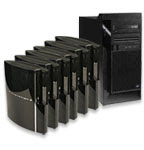
The first, experimental Infrant ReadyNAS NV+ unit arrived just before the weekend. I say experimental, as in the longer run I plan to base a significant part of my home computer / entertainment network on these devices. I have picked the ReadyNAS for several reasons. Basically it is a storage server or even simpler a hard disk with Ethernet interface. There are many units like that on the market. The Infrant is special for several reasons, most of them seem important to me: It has redundancy built-in. Up to 4 SATA drives (my initial unit has just two with two empty expansion slots) in various RAID setups. Hard drives do fail. So if you think of storing a significant amount of data, the drive setup should be redundant. In my configuration the Infrant box will have 4x500GB drives, resulting in a 1,5TB capacity with redundancy (4th drive). 500GB drives seem to sin in a capacity/price sweetspot and typical home should do fine now with 1,5TB. Later when larger drives become cheaper the sto...

Telecom 2.0

Image
I have just returned from the NMS Communications Connect conference taking place in Madrid, Spain. They did a very good job selecting the speakers and panelists. There were many, including Brough Turner, the CTO of NMS who confirmed my earlier musings of voice (quality) being the killer application of a next generation telephone network. Brough said - and I do agree - better voice could be more pervasive than anything else. Remember - at the moment our conversations utilize the same bandwidth they used to 100 years ago. Finally the industry starts to understand? Good, better late than never... Community services, Facebook included, and user generated content in general, were the hot topic as well, when the participants finally seem to agree with the Telecosm law of separation of content from conduit. I could hear "we need more content innovation" and while "consumers are smart, not dumb as most of the carriers used to think", the "locked-in users turn into a...

Nikon S51C Connected Camera

Image
Last week when I wrote about the Momento Connected Photo Frame , I said in the last paragraph " What we really need now are cameras able to upload photos to Picasa with a press of a button. ". Wishes do come true (more on that later...). Here comes the Nikon Coolpix S51C, a compact point and shoot camera, with built-in WiFi. According to Nikon's press release, the S51C can upload images to Flickr. Really exciting! My Momento frame, ordered a week ago, is still somewhere in transit, I hope to get it tomorrow... And after reading the Nikon's specs on the S51C, I was almost ready to buy one. What a nice couple they would be: snap a photo with the camera, press a button and off it goes instantly to Flickr, where it is immediately pulled from by several photo frames scattered around my family. Imagine myself being in Australia, taking a picture of Ayers Rock and my Mom having it displayed automatically on her photo frame in a matter of seconds. No computers in between. No ...

i-Mate Momento: Connected Photo Frame

Image
I remember back in 1987 at the university, we had a lecture on liquid crystals. Two weak points were mentioned in reference to this technology: first, the LCD displays were monochrome, and second, they were too slow to be used to display motion pictures. Five years later I bought my first color LCD laptop (so called active matrix those days) and it had bright and clear and fast LCD display, violating just about everything I had learned about liquid crystals a few years before. The drawback was the price, something in the range of 10 thousand dollars. And today? We have LCDs everywhere. From watches to mobile phones to digital cameras to MP3 players to computers to TV sets... And now even the photo frames have LCD displays. That is natural... why use paper to print digital photos, when you can upload them directly to a "frame". Or a couple of them. As I write, a typical, decent 7 or 8 inch photo frame costs some 100 dollars. They used to have fairly low resolution (480 horizon...

Graphics Processors (GPUs)

Image
For years ATI and NVIDIA, known for their high performance graphics boards, have been the synonyms of fast games. Recently everybody have been talking about Sony PS3 and its ultra high performance graphics based on the NVIDIA RSX engine coupled with the Cell processor. And suddenly it looks like what was initially designed for games finds its way into high performance servers. A few days ago Wired reported about an astrophysicist who replaced his number - crunching supercomputer with a cluster of PS3s. This trend becomes even more mainstream, as some serious companies offer serious programming tools. Terra Soft Solutions has a version of Linux tailored for the PlayStation and RapidMind offers its stream programming toolkit for the console. This year's acquisition of PeakStream (a competitor to RapidMind) by Google amplified the trend even more. All these platforms and solutions share a common paradigm - multiple processing cores and parallel execution of tasks. What seems now a ...

di-GPS (a GPS solution for Nikon and FujiFilm)

Image
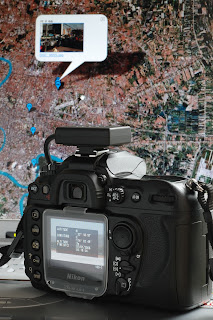
Exactly a year ago I posted about GPS devices. Part of the post was about GPS - enabled cameras and how automatic geo-tagging of pictures would streamline the process of sharing and storing the pictures. Now after a year the GPS technology has made inroads into many consumer products, but I am still not aware of any consumer photo camera with built in GPS unit. On the other hand as some of you already know, I have been shopping for a new DSLR camera recently. I finally settled on the FujiFilm S5 Pro and one of the important contributors to my decision (versus Sigma SD14) was the GPS support. The FujiFilm S5 Pro is an interesting design, as it is based on the Nikon D200 body (I posted on the S5 Pro last month), and supports most of the accessories designed for the Nikon, GPS being one of them. I was naive to expect the Nikon GPS solution would be elegant. But the reality is Nikon is not an iPod and while being a "professional" it is quite often bulky and conservative. So how...